

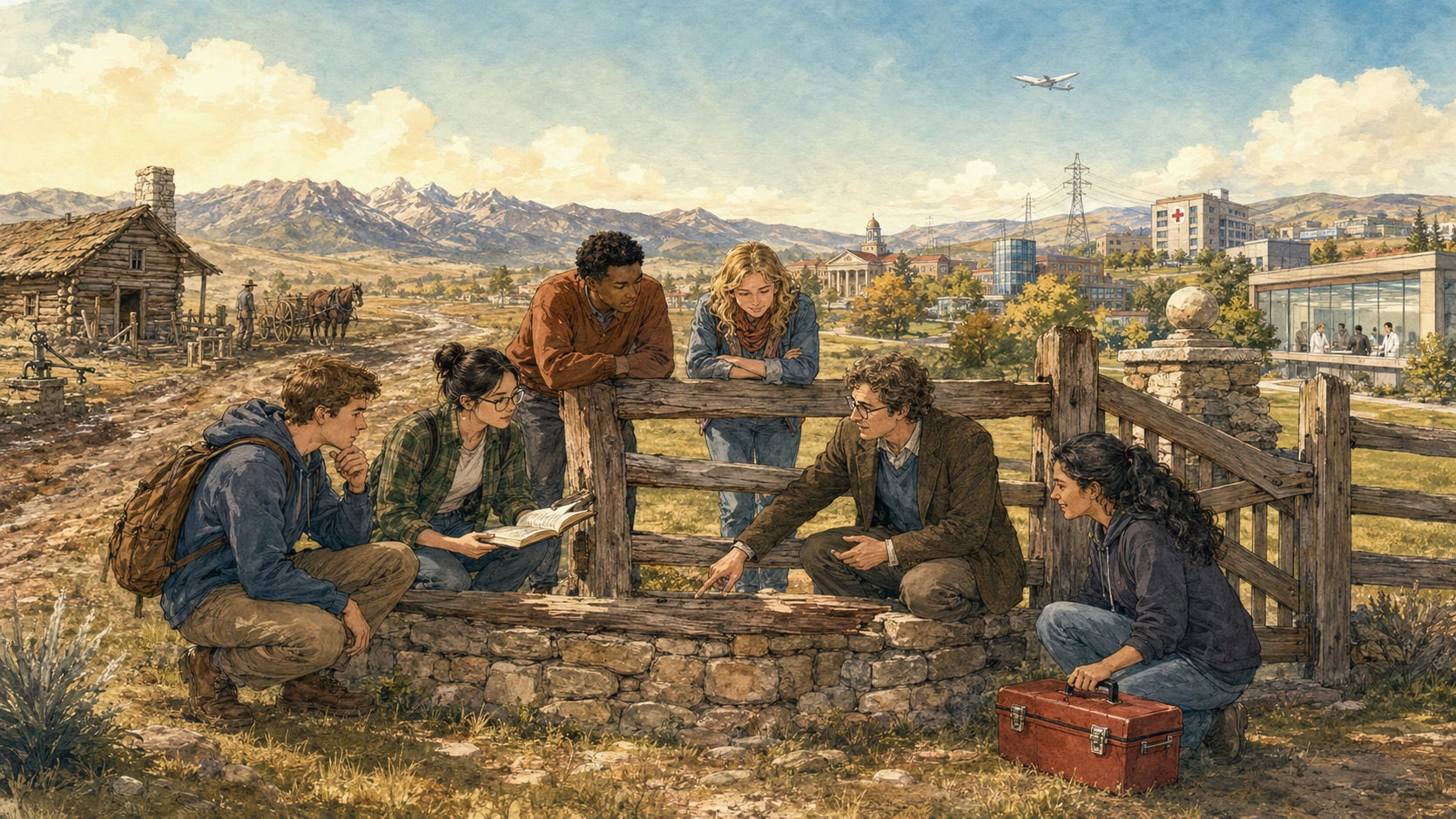
Don’t take a fence down until you know why it was put up, writer G.K. Chesterton famously cautioned.
If America’s founding institutions and ideals are the fence, polls suggest that some young people want to take parts of it down. For example, 34% of adults under age 30 say they have a favorable view of communism; 19% say violence is sometimes acceptable to stop “harmful public speech”; and 38% say free expression should sometimes be restricted when it conflicts with “social harmony”. Popular left- and right-wing podcasters earnestly argue that the wrong side might have won World War II and the Cold War.
Young people are free to believe and argue for whatever they want, of course. They should be given opportunities to explore a wide range of ideas and ideologies during their formative years, and they should be given grace to try on different worldviews and change their minds.
But education systems should also teach young people why the fence of American institutions was put up—and what its fruits have been—so they at least know what they’re arguing against if they choose to do so. Our state leaders understood this when they passed statute 21-9-102 requiring publicly funded schools to teach students “the principles of the constitution of the United States and the state of Wyoming”.
This fall, I am launching a new course at the University of Wyoming (UW) meeting this requirement called “American Economic Success” (ECON 12001). The course is organized around a simple question: How rich are Americans today, compared to other places and times in history, and why?

I will start by asking students to imagine their daily lives around the time of the country’s founding. Gross domestic product (GDP) per capita was roughly 4% of what it is today, controlling for inflation and cost of living. Life expectancy was less than 40 years, half of what it is today. As many as one-third of children died before age 5; less than 1% do today. Children and male adults over 65 typically worked, unlike today. Women couldn’t vote and very few white women worked. The average woman had seven children. Slavery was legally practiced, not just in parts of the U.S., but almost everywhere in the world.
Forget computers, cell phones, and airplanes—there were also no refrigerators, cars, or sewer systems, and no modern medicine. We didn’t know what a germ was, let alone have penicillin or vaccines. We went to the bathroom in outhouses when the weather was nice, and “chamber pots” (exactly what it sounds like) when it wasn’t. We used things like corncobs, leaves, or old pamphlets instead of toilet paper. Today, even in Burundi—one of the poorest countries in the world—the average person’s life is substantially better by most of these measures.
University of Pennsylvania economist Jesús Fernández-Villaverde illustrated some of the grim realities of early American life on X yesterday, using the example of Henry Clay.


So, Americans’ lives have gotten a lot better over time, but what about compared to other places today? I’m guessing most young people know that Americans have much higher incomes than the average person in low- and middle-income countries. But how many know that Americans in many professions earn 50-100% more than their British counterparts, or that U.S. GDP per capita is roughly 40% higher than the European Union’s? This is why this past summer’s World Cup produced countless viral videos in which foreign visitors were stunned by the abundance Americans enjoy.
Like any country, America has problems, too. A few—like housing affordability—may be getting worse, on average. A few others—like personal health and gun violence—stand out among high-income countries and compare poorly to many middle-income countries. But many of the problems that preoccupy young people—though real—are less severe in America today than in almost every other place and time in world history. These include, for example, incomes among the bottom 20%, prejudice against women and ethnic and religious minorities, air pollution, and death rates from natural disasters.
The key institutions and ideals of a country, whose strengths are relatively unique and whose flaws are relatively common in world history, ought to be studied.
What have been keys to American economic success? My class will review several reputable theories from across the ideological spectrum, and data supporting each. They suggest that markets, economic freedom, and private property rights; rule of law; democratic governance; public support and private incentives for science and innovation; trade and skilled immigration; and norms of interpersonal trust, responsibility, and hard work have been important, among other things. Students will be given opportunities to discuss and debate these claims.
To put the drivers of economic success—and their connections to U.S. and Wyoming founding documents—into real-world context, students will hear from guest speakers, including UW alum and former energy executive Skip York, and Wyoming Attorney General Keith Kautz.

One of my favorite things about being a professor is seeing students’ passion, idealism, energy, and creativity. If we can mix these traits with a bit of knowledge and appreciation of economics, civics, and history, along with a willingness to count our blessings as diligently as we look for problems in society, hopefully our students will be empowered to create a more perfect state and union.
Go Pokes!
Students wanting to take my course should note that, for administrative reasons, it is currently still listed in the UW calendar this year under its previous name, “Economics, Law & Government” (ECON 1200).
This course on medical history is related
https://substack.com/home/post/p-212071923
This is great. What I think matters a lot is that the study is empirical, as is the study of how to evaluate the question - it’s good if eg critics point out what *isn’t* being evaluated. But they should do so in full view of what the baseline situation we inherit is.