

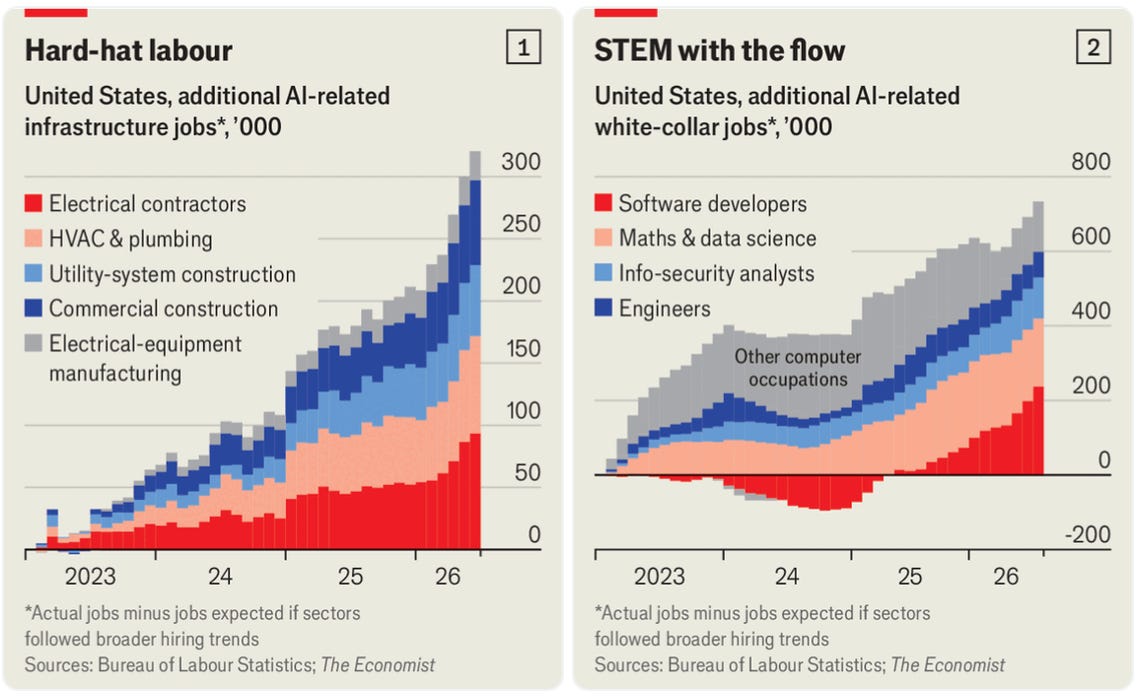
The Economist just published an analysis of AI’s effects on the U.S. labor market. They estimate that AI has created roughly one million new jobs, compared to roughly 200,000 destroyed—a net gain of roughly 800,000 jobs. As the figure above illustrates, AI is creating jobs across broad swaths of the economy, in both traditional “blue collar” (skilled trades) and “white collar” occupations.
The Economist’s conclusion—that AI is creating more jobs than it’s destroying—is supported by many other independent analyses, as Noah Smith describes here. Smith also describes how surprising these good news might be to the average American. For example, a 2026 Pew survey found most young people were “concerned” about AI and an overwhelming majority of Americans thought that AI would destroy more jobs than it would create.
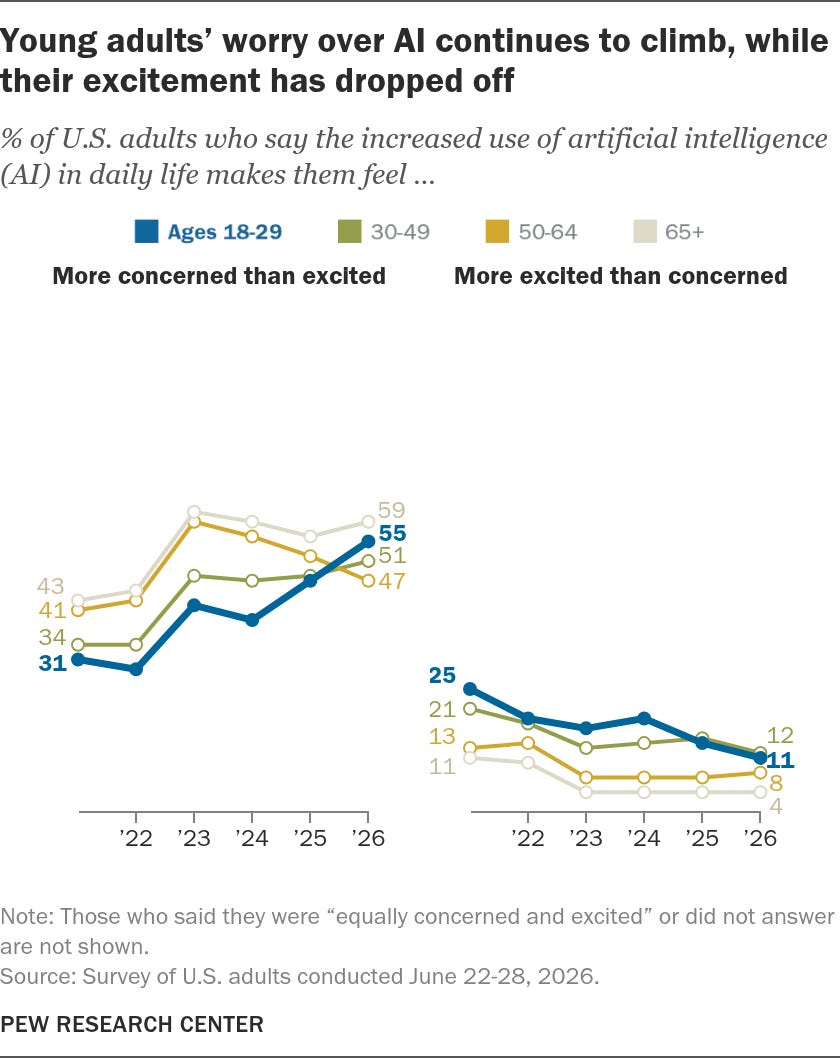
Doomerism about AI’s effects on the labor market adds to other types of AI doomerism young people might be sensitive to, e.g., ‘AI is destroying education’; ‘AI could cause the apocalypse’; and the somewhat more rational ‘AI misalignment poses major cybersecurity threats’.
AI CEOs haven’t just been ineffective at pushing back against these narratives, they’ve been fueling them in some cases! AI doomerism from AI CEOs in the 2020s will be a classic case in bad marketing for future business school students to study.
“We’re going to take your jobs away and we might ruin your society, but can we please build a data center in your community?”
Why AI is creating more jobs than it’s destroying
Historically, major technological innovations have always ended up creating more jobs than they destroyed. So, AI is the rule here, not the exception. The logical error people make when assuming jobs will be destroyed is jumping from “AI is automating tasks” to “there will be fewer tasks for people to do”. This only makes sense if we assume that the total number of tasks (done by humans plus machines) is fixed. Why would that ever be the case?
In fact, when we mechanize some tasks, it frees up time and resources for new tasks, and the innovations fueling mechanization also create new production possibilities that didn’t exist before. These things increase overall productivity and affluence.
When we mechanized agriculture, people’s time was freed up to pursue industrial activities in cities. When we mechanized sewing, people’s (especially women’s) time was freed up to pursue other productive and creative activities. The invention of the Internet has created a huge number of professions that didn’t exist before. The same is likely to be true with AI. For example, in Episode 15 of Grounded, Not Divided, my brother Ian described how AI is creating demand for hyper-customized software development services (not to mention construction, hardware, energy, and mining jobs).

The same logic applies within many professions. In academia, for example, it’s absolutely true that AI can perform tasks in hours that might have previously taken graduate research assistants a whole semester. Does that mean we shouldn’t hire graduate research assistants anymore? No! That would only follow logically if the total number of tasks we did as academics was fixed. But it’s not.
Instead of having grad students spend a semester painstakingly entering and cleaning data, for example, we can now have them spend most of the semester analyzing data, and exploring new cutting-edge ideas, with the help of AI. If a neurosurgery resident can solve a major decades-old math problem, in his spare time, with the help of AI, imagine what your next grad student might be able to do! If you’re a new grad student, imagine what you might be able to do!
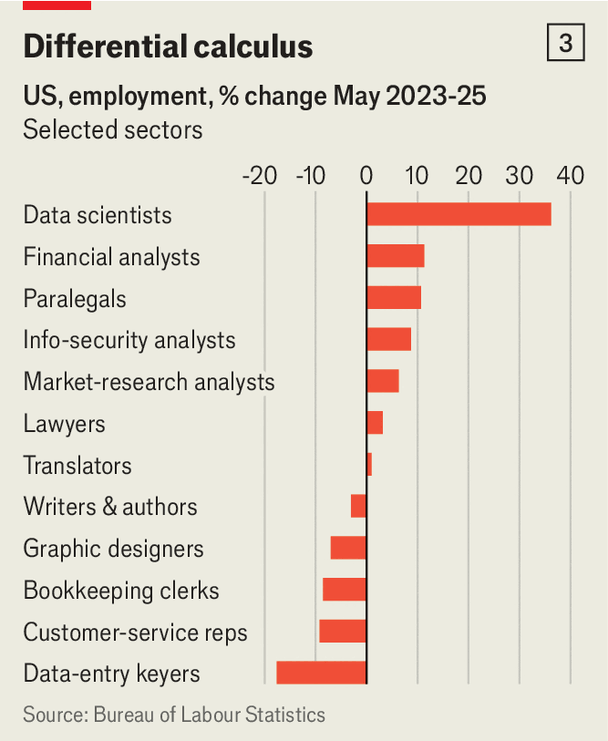
Of course, there are a few professions where AI genuinely does threaten jobs. These are the professions where the number of tasks is relatively fixed. For example, the invention of sewing machines really did cost seamstress jobs, and there are far fewer people working in agriculture today than before it was mechanized. AI is destroying jobs in data entry, bookkeeping, and graphic design, The Economist estimates. (Interestingly, paralegal jobs—an area I thought might have similar challenges—have increased.)
There are also some creative industries where—even though it’s unclear to me whether AI will ultimately create or destroy jobs on the net—there is sure to be upheaval. For example, AI tools have the potential to transform songwriting and sound editing, but they are unlikely to change the demand for music, and they are unlikely to automate or reduce demand for live music. In these professions, my best guess is that innovators will be rewarded and Luddites will lose out, regardless of what the overall net-effect size is. So, be an innovator!
How AI could make education better
Many college students and higher-education leaders are worried about AI. The classic doomer scenario is one where college instructors use AI to teach and grade, while students use AI to cheat on their homework and exams. The college degree loses its market signal, and the education has little value beyond what a student could do in their bedroom with an AI subscription. On top of this (in the doomer narrative), the students are now entering a job market where AI has depressed the demand for their skills.
There are small grains of truth to some aspects of this narrative. College students really will use AI to cheat on take-home assignments and exams, in high numbers, if we let them, for example.
To support the broader doomer narrative about higher education, people often point to trends like recent declines in wage and employment premiums for college graduates, and declines in college enrollment, which have been earlier and sharper than demographic trends predicted (see the graphs below).
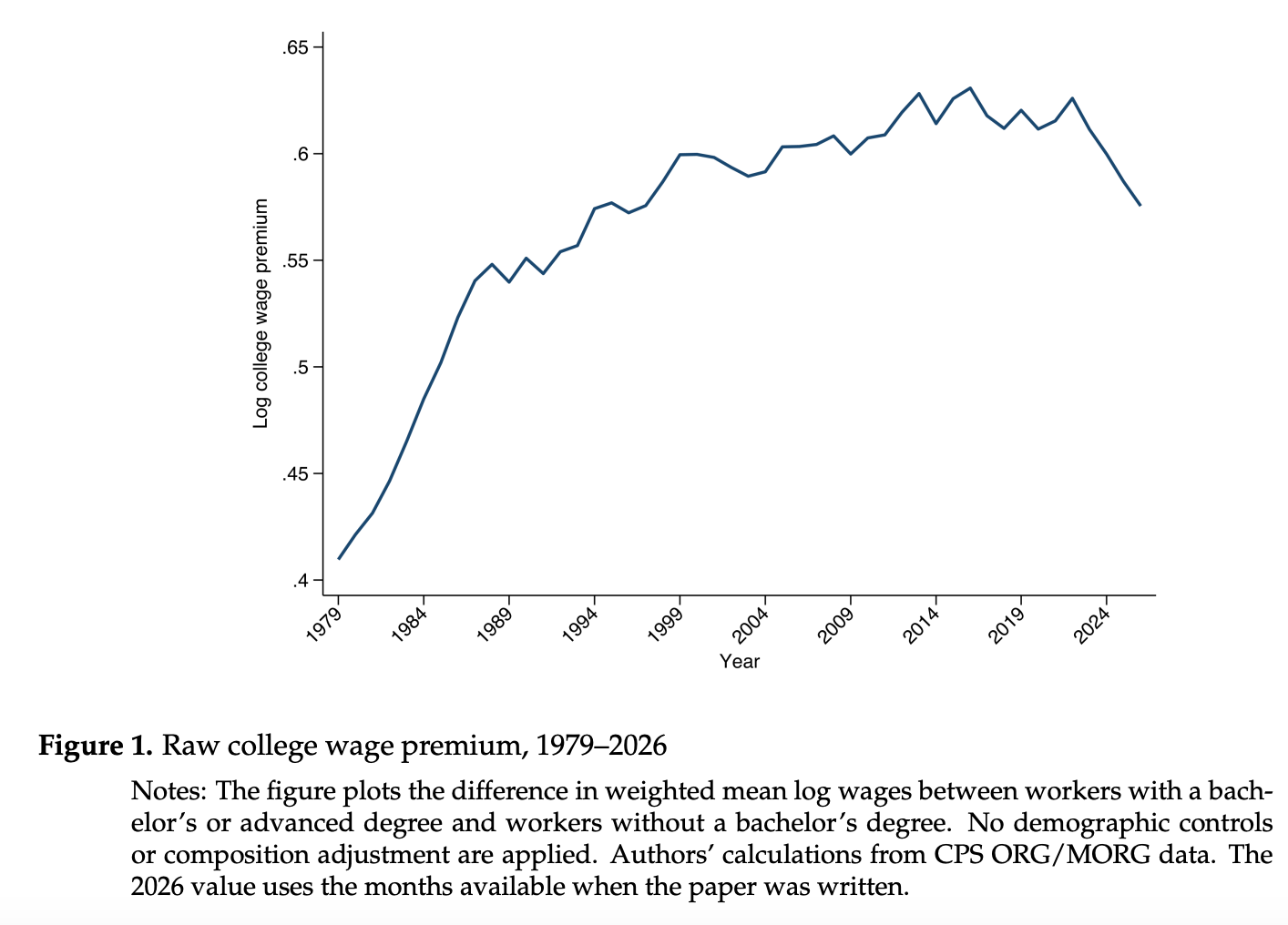


These trends certainly are concerning for higher education—a sector facing sure financial upheaval, for demographic reasons, regardless—but we risk learning the wrong lessons if we don’t look more closely at what these data are telling us.
For example, wage and employment premiums measure job prospects for college graduates compared to non-college graduates, not college graduates’ raw prospects. If AI increases non-college employment prospects by contributing to a boom in demand for skilled trades, that can reduce the college wage premium without implying that the quality of a college education has gotten any worse.
College wage and employment premiums could also have been affected by the past decade’s declines in public trust in colleges, driven by things like politicization of instruction, de-prioritization of excellence to increase the appearance of equity (often to the detriment of both objectives), and administrative bloat driving up costs. The Azar et al. study quantifying the declining college wage premium (shown above) attributes less than 30% of this decline to AI exposure in college-educated professions.

Despite the short-term challenges and upheavals AI is posing for colleges, here are some bigger-picture reasons why college leaders and students should be optimistic:
Technology can’t replace the residential college experience. During COVID, there were warnings of a coming ed-tech displacement of colleges. After being forced online by lockdowns, the story went, students would realize that they were wasting their time and money getting an education in four years on campus that they could get much faster and more cheaply in their bedrooms. What actually happened, of course, is that online COVID school was awful—harming students’ mental health and learning—and there wasn’t a mass rush by students and parents to try to make that model permanent. Instead, students and parents realized that many of the most important formative aspects of the college experience happen outside the classroom. These aspects of the college experience aren’t any more easily disrupted by AI than they are by ed tech. But college leaders should still make sure to foster them diligently. For example, they should insist that faculty be present on campus during the school year; they should not let residential students take most of their courses online; and they shouldn’t let their campuses and graduations be overrun by law/school-policy-violating protest encampments.
AI could be a great learning enhancer and equalizer of opportunity. I encourage the students in my classes to think of AIs as a very smart TA who is available 24/7 and endlessly responsive. As long as professors have learning evaluations that can’t be cheated with AI (e.g., in-person exams), students maintain the incentive to actually learn the material, and the AI assistance becomes all upside. Some people are lucky enough to grow up with highly educated parents who are able to invest time in enrichment activities, help them understand concepts at school, etc. That was my experience. Most people aren’t so lucky, though. My wife, for example, was the first in her family to go to college, and her parents worked 70-hour weeks running a small business to support their family (the classic story, in Canada and the U.S., of hard-working immigrants who have benefitted their countries and deserve respect). AI can level the playing field here. Claude is now smarter and better at explaining things than most parents are (no offense, Dad). If my wife and I were both in college today, we could both ask Claude for help explaining concepts, and the fact that I could also call my parents wouldn’t give me as much of an unfair advantage.
Professors still can add a lot of value beyond AI. If every student has AI in their pockets, why do they still need professors at all, one might ask? Here is where professors need to both have a little faith in themselves and step up their (our) games. As anyone who has used AI as a research aide knows (something every professor should be doing at this point, in my view), a subject-matter expert with good critical-thinking and research skills can do a lot more with the help of AI than someone without these skills and just an AI. So, the value we can add to our students’ education, by imparting and focusing on these skills, is as high as ever. Imagine going back 20 years in time and asking professors to imagine a situation where a major donor to their college paid for every student to have a super-smart personal tutor. Would the professors, in that scenario, throw their hands up and say: “our jobs are useless and students won’t be able to learn now”? No! They’d say exactly the opposite, and they’d be energized to do their jobs with such abundant resources available to help their students. This is the attitude professors should have about AI.
AI should allow students to dream big. As I mentioned above, a neurosurgery resident (i.e., a very, very busy person with little spare time) recently solved a major math puzzle in his spare time with the help of an AI. If that story doesn’t tell you that the sky’s the limit for your students (and you), I don’t know what would. Before AI, the most we professors could aspire to was training undergraduates who were ready to start another 4+-year journey to get to the cutting edge of their fields after graduating. Now, we can aspire to so much more, and so can our students. How exciting!
AI could make entry-level jobs more interesting. Before AI, an entry-level white-collar job might consist of mostly data entry and simple data analysis of relatively narrow questions. Now, with AI, a single undergrad can learn to build hyper-customized accounting software for a company, from scratch, in a month (a real example my brother, Ian, discusses in our podcast episode, linked above). So, our students will have the opportunity to start their careers doing incredible things! Their future employers will hire them expecting them to be able to do incredible things. So, we had better be spending the four years that we have with them empowering them to do incredible things, which requires believing they can. In other words, we need an optimistic and AI-forward approach to college teaching.
I am definitely still figuring out how to do AI-forward teaching myself (the optimism part comes more naturally). In case it is helpful to others, here are my syllabi for this semester (for a graduate macroeconomics class and an undergraduate economic history/civics class), which include my AI policies. I welcome feedback, criticism, and suggestions for better approaches. I’m sure better approaches exist! But I’m also pretty sure that any approach to instruction that isn’t AI-forward (except in a few very specific classes) will soon be obsolete.

(I wrote about the ECON 1200 class previously here:)

Take AI safety seriously, but resist doomerism
By saying that young people (and college professors) should be optimistic about AI—and that many AI doomer narratives do not stand up to empirical and historical scrutiny—I am not arguing against people paying attention to potential AI risks. For example, I think there are serious risks related to alignment (i.e., AI agents doing bad things by accident, thinking they are following our instructions) and cybersecurity (e.g., powerful AI hacking tools falling into the hands of criminals, terrorists, and hostile foreign governments). In fact, these risks are one of the reasons I think it’s important for the U.S. and other western democratic countries to lead on AI development. We want our defense to always be better than our adversaries’ offense. (This is something that data-center opponents and anti-AI politicians should keep in mind. It’s why the Chinese Communist Party is directly supporting anti-data-center propaganda in the U.S.)
But I am arguing for our leaders and intellectuals to examine both the opportunities and risks of AI, and to do so discerningly, objectively, and empirically. I have previously argued for a similar approach to tackling and educating students about climate change.
As Steven Pinker details in his chapter on “progressophobia” in Enlightenment Now, there are a variety of reasons why people have evolved to pay more attention to negative narratives than positive ones. People also tend to give more respect and attention to intellectuals (including book reviewers) with negative messages than those with positive ones, even if they’re wrong. Paul Ehrlich (author of The Population Bomb) was as consequentially wrong in his negative predictions as just about any academic in recent history, and yet he won basically every major scientific honor someone in his field could win. Ehrlich’s more prescient critics, such as Julian Simon, are far less well-known and academically celebrated.
It’s not just academics who profit from making inaccurate doomsday predictions. Far worse are the demagogues (though academics and intellectuals often enable and encourage the demagogues).
Modern western societies are built on broad economic, civil, and political freedoms. Doomsday predictions give governments (and their citizens) rational-seeming justifications to both curtail freedoms and allow instrumental suffering, with ends (avoiding the presumed doomsday) justifying means (oppressing or harming pesky opponents of the utopian political project that will save us from the presumed doomsday). As I once wrote in the context of climate change doomerism:
“It is worth imagining how far governments might be willing to go in curtailing civil liberties, and how much collateral suffering they might be willing to endure, if they were genuinely convinced that climate change put the fate of humanity on the line.”
Replace “climate change” with “AI” in that sentence, and much of the same logic applies. For example, doomsday predictions about AI causing mass unemployment and runaway inequality are incredibly useful to proponents of massive state interventions in the economy, including expropriation of private capital (“nationalize the AI companies!”). In the early-to-mid 20th century, somewhat analogous fears of runaway inequality and technological disruption—fueled (as they are today) by downwardly mobile highly educated elites, including college professors—gave us totalitarian communism, which is one of the deadliest things humans have ever done to each other.
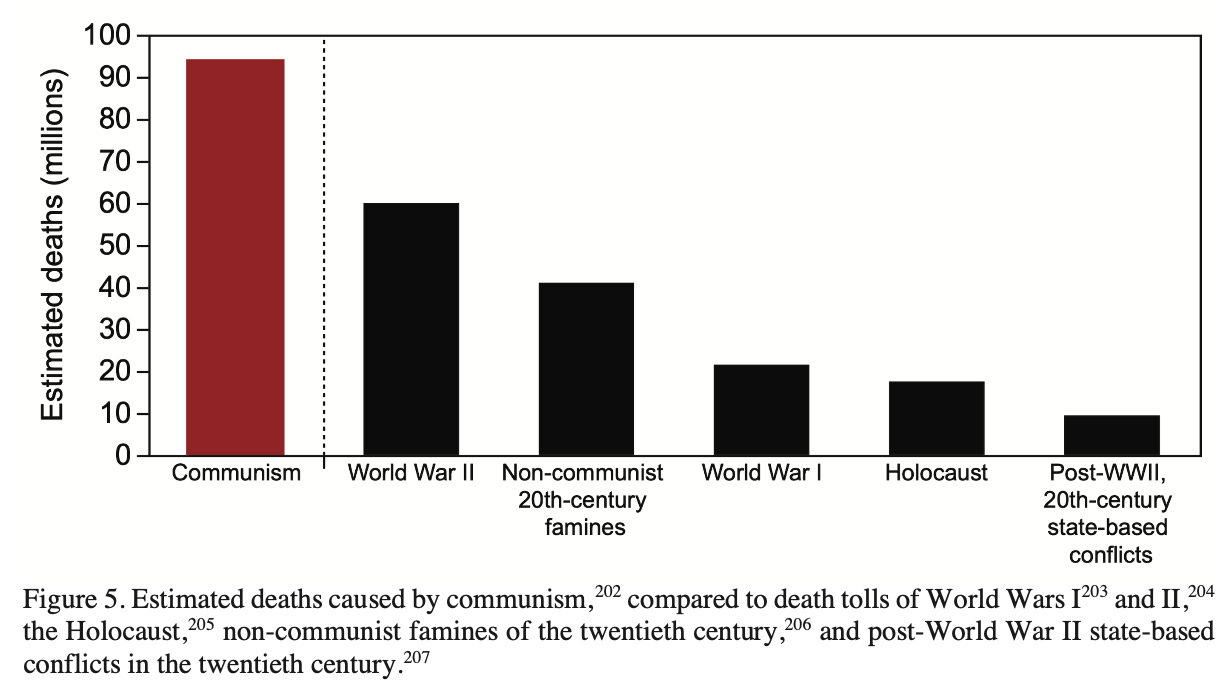
Besides demagoguery, inaccurate doomsday predictions also harm mental health, especially of young people. Young people are relatively susceptible to both mental health challenges and seduction by grand simplistic narratives about the world. There is again a parallel between today’s AI doomerism and recent doomerisms about climate change and other societal problems, which pervaded intelligentsia to the detriment of youth mental health for the past decade.
In sum
AI is here and it is doing big things. Some of these things are disruptive; a few are concerning; but most are exciting. The weight of evidence so far suggests that AI is creating far more opportunity for young people—including for their employment and education prospects—than it is causing harm. (And I haven’t even talked about the possibilities for AI curing diseases.) So, get excited, young people!
Next time you hear someone my age or older tell you that AI is wrecking your future, feel free to respond with “Ok, doomer.”
Clearly a lot of thought went into this piece, and I think it articulates well the opportunity side of AI. That said, I don't think we have any real grasp on how this is all going to turn out (labor and otherwise). I believe prediction is beyond our ability right now. Meanwhile let's not overlook the positives, and be prepared to change with the times. Thanks for your diligent work.
Matt, there is a bias toward doomerism in our current media and social environment, I don't know why. It's like you get more points in some game somewhere where you only get points for assessing risks, not rewards and saying mean things about other people.
Some NGOs make money from dooming, some media outlets get clicks from dooming. I think it's a worthy mission to present the other side. So thank you!